

If you are selling investment or business real estate and plan to reinvest in another property, understanding the 1031 exchange requirements before you close is essential. A missed deadline, an ineligible property, or mishandled sale proceeds can put tax deferral at risk. Von Rock Law works with clients on real estate transactions and can help you understand the legal issues involved in planning a transaction.
Discuss a California real estate transaction
A Section 1031 exchange may allow you to defer recognition of gain when qualifying real property held for business or investment is exchanged for other qualifying real property. It is a tax-deferral rule, not a tax-free sale. The details matter, and federal rules apply alongside California reporting requirements. This guide focuses on the requirements that commonly determine whether an exchange can proceed.
What Are the Key 1031 Exchange Requirements in California?
Start with the purpose for holding both properties. Under federal law, Section 1031 applies to real property held for productive use in a trade or business or for investment. It generally does not apply to a home you use primarily as your personal residence, property held mainly for sale to customers, or personal-use assets. The IRS explains that qualifying like-kind exchanges generally do not require gain or loss to be recognized at the time of the exchange, subject to the rules and exceptions that apply.
The taxpayer that transfers the old property generally must be the taxpayer that acquires the replacement property. A change in ownership between the sale and purchase can create complications. For example, an individual selling property and a newly formed entity taking title to the replacement property may not be treated as the same taxpayer. Entity and trust ownership, co-owners, partnerships, and changes in ownership deserve advance review rather than an assumption that a simple name change is harmless.
Pay special attention if the property is held through a partnership or multi-member entity. A partner who wants to leave with a share of the proceeds may have different goals from the entity that owns the real estate, and a distribution or buyout around the exchange can raise separate tax questions. Likewise, co-owners should agree early on whether the ownership and acquisition structure will continue consistently. Do not assume every owner can make a separate election after the property has been sold; have tax and legal advisors review the proposed structure before the sale contract and closing documents are finalized.
Intent and actual use matter. Keep records that help show how the relinquished property was held and how you plan to hold the replacement property. Relevant records can include leases, business records, purchase documents, and communications about the property’s use. There is no single holding period that automatically makes every property eligible. A short period of ownership may invite questions about the taxpayer’s purpose, so get advice specific to your facts.
For a general overview of the tax-deferral concept, see Von Rock Law’s guide to what a 1031 exchange is. The exchange’s eligibility, timing, and tax effects still need to be assessed for the actual properties and parties involved.
What does “like-kind” mean for California real estate?
For Section 1031, “like-kind” describes the nature or character of the real property, not whether the properties are identical in quality, grade, or use. A qualifying U.S. investment property may, in many cases, be exchanged for a different type of U.S. investment real estate. For example, an apartment building is not necessarily disqualified simply because the replacement is a different kind of real estate. The property must still meet the business-or-investment-use requirement.
Since the federal law change that took effect in 2018, Section 1031 treatment is generally limited to real property. Personal property such as vehicles, equipment, or artwork does not become eligible just because it is transferred with a building. If a transaction includes both real estate and other assets, identify and analyze each component rather than treating the entire deal as one qualifying exchange. The IRS’s real estate tax tips for like-kind exchanges summarize the federal framework.
Property outside the United States generally is not like-kind to property within the United States. Other exclusions and special rules may apply as well. A contract should describe the property and the assets being transferred accurately, and the tax treatment should not rest only on a label in the purchase agreement.
What are the identification and exchange deadlines?
In a typical deferred exchange, two deadlines control the schedule. The 45-day identification period begins on the date you transfer the relinquished property. You must identify potential replacement property in writing within that period. The exchange period generally ends 180 days after the transfer, or on the due date of your federal income tax return for that year, including extensions, if that date comes first. The federal statute sets out these time limits; see 26 U.S.C. Section 1031.
These are calendar-day deadlines, and they are not ordinarily extended just because you are still negotiating, waiting for financing, or having trouble finding a suitable property. Mark both dates as soon as the sale closes. If your tax-return due date could shorten the 180-day period, speak with a tax professional about filing an extension in time; an extension may affect that deadline, but it does not extend the separate 45-day identification period.
| Requirement | Core rule |
|---|---|
| Identify property | Written identification within 45 days after transferring the old property. |
| Complete exchange | Acquire replacement property within 180 days, or by the earlier applicable return due date. |
| Use a valid identification | Observe the identification limits and describe the property clearly enough to identify it. |
You generally can identify up to three properties without regard to their combined value. If you identify more, other limits apply, including a 200% value rule and, in some circumstances, a 95% acquisition rule. These are regulatory identification methods, not a reason to send a vague list of every property you might someday consider. A qualified tax advisor or intermediary can help confirm the applicable method and the written identification procedure for your exchange.
Identification is not the same as acquiring the property. You must acquire qualifying replacement property by the applicable exchange deadline, and it must satisfy the rules for property identified or otherwise permitted under the governing requirements. Preserve dated copies of notices and delivery confirmations. If an acquisition fails, a substitute is not automatically acceptable simply because the original deal fell through.
How does a deferred exchange usually proceed?
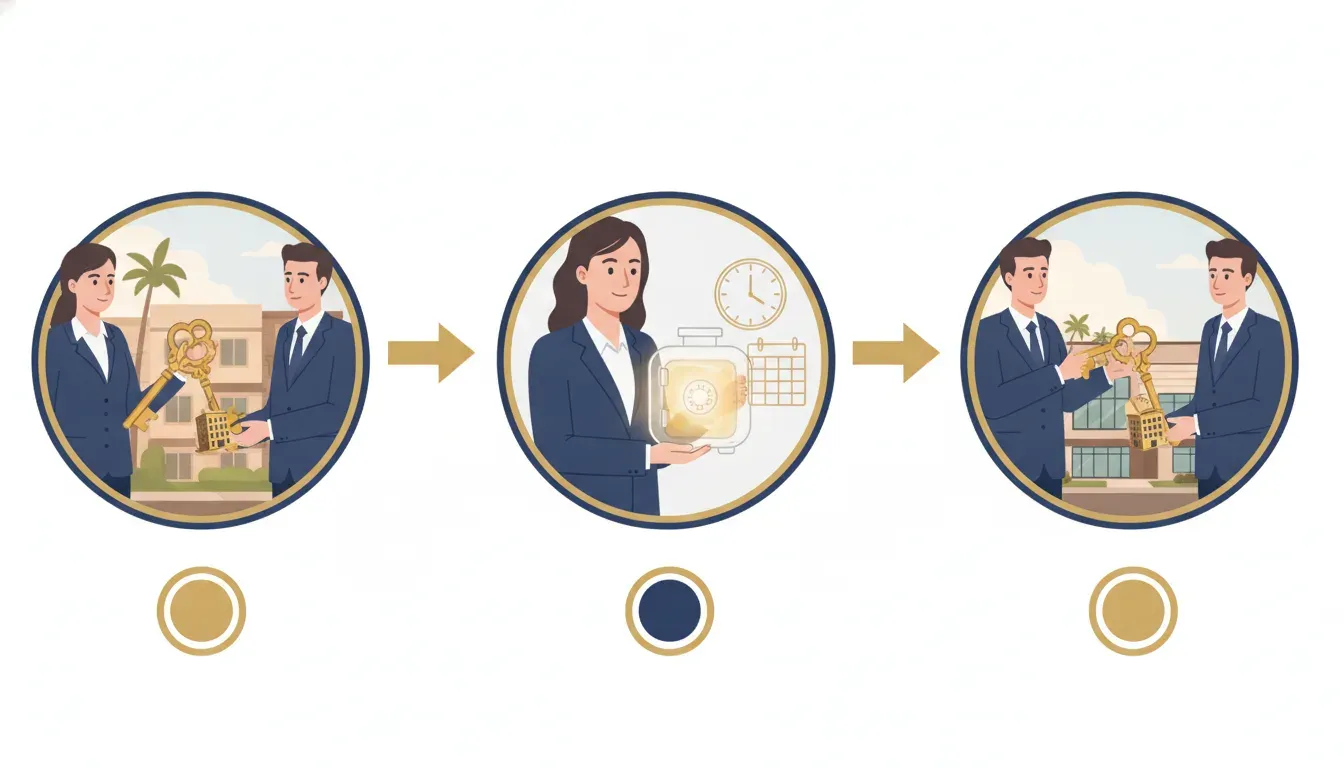
A deferred exchange is not usually a simultaneous swap between two owners. Instead, it is structured as a linked series of steps. Before the relinquished property sale closes, the taxpayer and QI put the exchange documents in place. The sale closes, and the proceeds are handled under the exchange arrangement rather than paid directly to the taxpayer. The taxpayer then identifies potential replacement property in writing and, within the applicable exchange period, acquires qualifying replacement property.
Escrow, the QI, the buyer, the replacement-property seller, lenders, and the taxpayer may all need coordinated instructions. A purchase contract may need assignment or notice provisions to reflect the exchange, but the parties still complete their respective sale and purchase closings. The contractual mechanics should be reviewed before execution. Tell the other transaction professionals about the planned exchange early enough for them to prepare accurate documents and coordinate funds.
Before signing, confirm who will be named as the transferor and the acquiring owner, how the QI will receive funds, and what information the QI needs for an identification notice. Also confirm whether the replacement acquisition depends on loan approval, inspections, or other conditions that could affect timing. A backup property can be useful, but it only helps if it is validly identified and can be acquired under the rules. The sequence is a planning framework, not a substitute for the required agreements or transaction-specific tax advice.
Why does the qualified intermediary matter?
In a deferred exchange, the way sale proceeds are handled is critical. If you take control of the proceeds, even briefly, the IRS may treat you as having received the sale proceeds rather than having completed an exchange. A qualified intermediary (QI) is commonly used to hold and transfer exchange funds under a safe-harbor structure. The QI also helps document the exchange and coordinate the transfer of proceeds to the replacement-property closing.
Choose the QI before the sale closes, and make sure the exchange agreement and assignment documents are in place at the appropriate time. Do not assume you can close a normal sale, deposit the proceeds in your own account, and later convert the transaction into an exchange. The QI is not simply an escrow account you can arrange retroactively. Review the QI’s written agreement, fees, procedures, and handling of funds. Ask how funds are protected and what happens if a purchase does not close on schedule.
A QI is not a substitute for tax advice, legal review, or careful transaction planning. The QI’s role and limitations should be clear to every party involved. For a more focused discussion, read Von Rock Law’s article on qualified intermediary rules in California.
What is boot, and when can it create taxable gain?
“Boot” is a common term for cash or other value received in an exchange that is not like-kind replacement real property. It can arise when you receive cash at closing, take certain nonqualifying property, or receive debt relief without taking on enough replacement debt or adding cash to address the difference. The exact calculation depends on the transaction, including liabilities, expenses, and realized gain.
Receiving boot does not necessarily mean the entire exchange fails. It may mean that some gain is recognized, generally limited by the amount of realized gain and the applicable tax rules. Conversely, buying a more expensive property does not by itself prove that every requirement has been met. You should have a tax professional model the expected sale proceeds, replacement purchase, debt, and any cash contribution before committing to the deal.
Consider a simple planning example: you sell an investment property and use exchange funds toward a replacement that costs less. If you receive the unused balance, that cash may be boot. If the replacement property has less debt, the debt reduction may also need to be considered. This is only a general illustration; the actual tax calculation can depend on other amounts and facts.
Deferral also affects the replacement property’s tax basis. In general, the basis is adjusted under tax rules that account for the exchanged property’s basis and the details of the transaction. It is not necessarily the replacement property’s full purchase price. That can affect taxable gain if you sell the replacement property later, as well as depreciation calculations. Ask your tax advisor to explain the projected basis and keep the exchange records with the property’s permanent tax file. Do not compare properties only by their purchase prices or assume that deferring gain removes it.
What California reporting issues should you check?
Federal deferral does not mean California reporting can be ignored. California has reporting requirements for certain like-kind exchanges, including situations in which California-source gain is deferred and replacement property is located outside California. The California Franchise Tax Board says Form FTB 3840 generally must be filed for the exchange year and each subsequent year until the California-source deferred gain is recognized or the reporting obligation otherwise ends under the applicable rules. Review the FTB’s guidance on reporting like-kind exchanges with your tax professional.
Keep copies of the exchange documents, closing statements, property descriptions, basis information, and relevant state and federal tax filings. If you move or later sell the replacement property, do not assume that the California connection has disappeared. The state reporting question can depend on where the relinquished property was located, where the replacement property is located, your residency, and the history of the deferred gain.
Von Rock Law handles California real estate transaction matters, but tax reporting decisions should be reviewed with a qualified tax professional who can consider your complete federal and state tax picture. You can explore the firm’s real estate services to learn about its transaction practice.
What common mistakes can jeopardize an exchange?
- Waiting until after closing to plan. The QI and exchange documents generally need to be arranged before you transfer the old property. Early coordination leaves more time to identify issues.
- Taking possession of the proceeds. Routing proceeds through a personal or business account can undermine the intended deferred-exchange structure. Follow the exchange agreement and closing instructions.
- Missing or miscounting a deadline. Calendar the 45-day and 180-day dates from the transfer date, and account for the return due-date limit. Do not rely on an informal estimate.
- Identifying property unclearly. A description that does not reliably identify the property, or an identification that exceeds the available limits, can create a serious problem. Use the required written process.
- Assuming any property qualifies. Personal-use property, property held for resale, personal property, or property outside the eligible category may not qualify.
- Changing the taxpayer or ownership structure midstream. The seller and buyer identity, entity status, co-ownership, or a partnership distribution can affect the analysis. Review the ownership plan before sale.
- Ignoring boot and transaction costs. Cash received, debt changes, non-like-kind assets, and closing items should be reviewed in advance, not after the return is prepared.
- Forgetting California’s continuing reporting. A deferred California-source gain may carry reporting obligations after the exchange year, especially when replacement property is outside the state.
Call Von Rock Law at (415) 517-3706 about your real estate transaction
What should you do before selling?
Use this sequence to get the right people and information in place before the closing date:
- Confirm the purpose and ownership. Identify how the property has been used, who owns it, and who is expected to acquire the replacement. Collect deeds, entity records, leases, and prior tax information.
- Talk with a tax professional. Ask whether both properties and the intended transaction may qualify, estimate potential gain and boot, and discuss federal and California reporting.
- Engage a QI early. Review the exchange agreement and fund-handling process before signing closing instructions. Coordinate the QI, escrow, and all relevant parties.
- Build a realistic replacement-property plan. Identify likely candidates, financing needs, inspections, and backup options before the 45-day period starts.
- Calendar and document every deadline. Track the transfer date, identification date, exchange deadline, and relevant tax-return due date. Keep delivery evidence for every identification.
- Review final documents before signing. Check how proceeds, liabilities, property descriptions, and any non-real-estate assets are treated. Confirm the intended structure with your advisors.
Depending on your situation, an exchange may be worth exploring, but it should not drive you into a purchase that does not fit your financial or investment goals. A tax deferral can have long-term consequences, including the carryover of tax basis. Compare the business and investment merits of the replacement property with the tax result, and consider what happens if an exchange cannot be completed on time.
Speak with Von Rock Law about a California real estate transaction
Call Von Rock Law about your California property exchange
Frequently Asked Questions
Can I use a 1031 exchange for my primary residence?
Section 1031 generally applies to real property held for business or investment, not a home used primarily for personal purposes. A property with mixed personal and rental use can require a more detailed analysis. Do not rely on the property’s label alone; discuss its actual use and records with a tax professional.
Do replacement properties have to be in California?
Not necessarily under the federal like-kind rule: U.S. real property may generally be exchanged for other U.S. real property if the other requirements are met. But a move from California property to out-of-state property can raise California reporting issues. Ask a tax advisor how Form FTB 3840 and any continuing obligations apply to you.
Can I receive some cash and still complete an exchange?
Possibly, but cash or other non-like-kind value may be boot and can cause some gain to be recognized. The result depends on the amounts and the full transaction. Have your advisor calculate the consequences before directing any proceeds.
What happens if I miss the 45-day or 180-day deadline?
Missing a required deadline can prevent the intended deferred treatment for a typical deferred exchange. The deadlines are strict, and a failed purchase or delayed financing does not automatically extend them. Get professional advice promptly if a deadline is at risk.
Contact Von Rock Law About a California Real Estate Transaction
Every exchange involves facts that can change the legal and tax analysis. If you are planning a California property transaction, Von Rock Law can discuss the transaction-side issues and help you understand what information to bring to your tax and other professional advisors.
A careful plan made before closing can help you evaluate eligibility, protect important deadlines, and make informed decisions about the property you sell and the property you acquire.
This blog is made available by Von Rock Law, PC for informational purposes only and is not intended to provide legal advice. The information contained herein may not reflect the most current legal developments and may not apply to your specific circumstances. Viewing this website, reading this blog, or communicating with our firm through this site does not create an attorney-client relationship. You should not act upon any information contained in this blog without seeking professional counsel from an attorney licensed in your jurisdiction. Unless otherwise expressly stated, our attorneys are licensed to practice law only in the State of California. Prior results do not guarantee a similar outcome.